
DMARC · DMARC Policy · DMARC Monitoring · Email Security · Use Cases
Move DMARC From p=none to Quarantine Without Disruption
· InboxPlacement.io Team
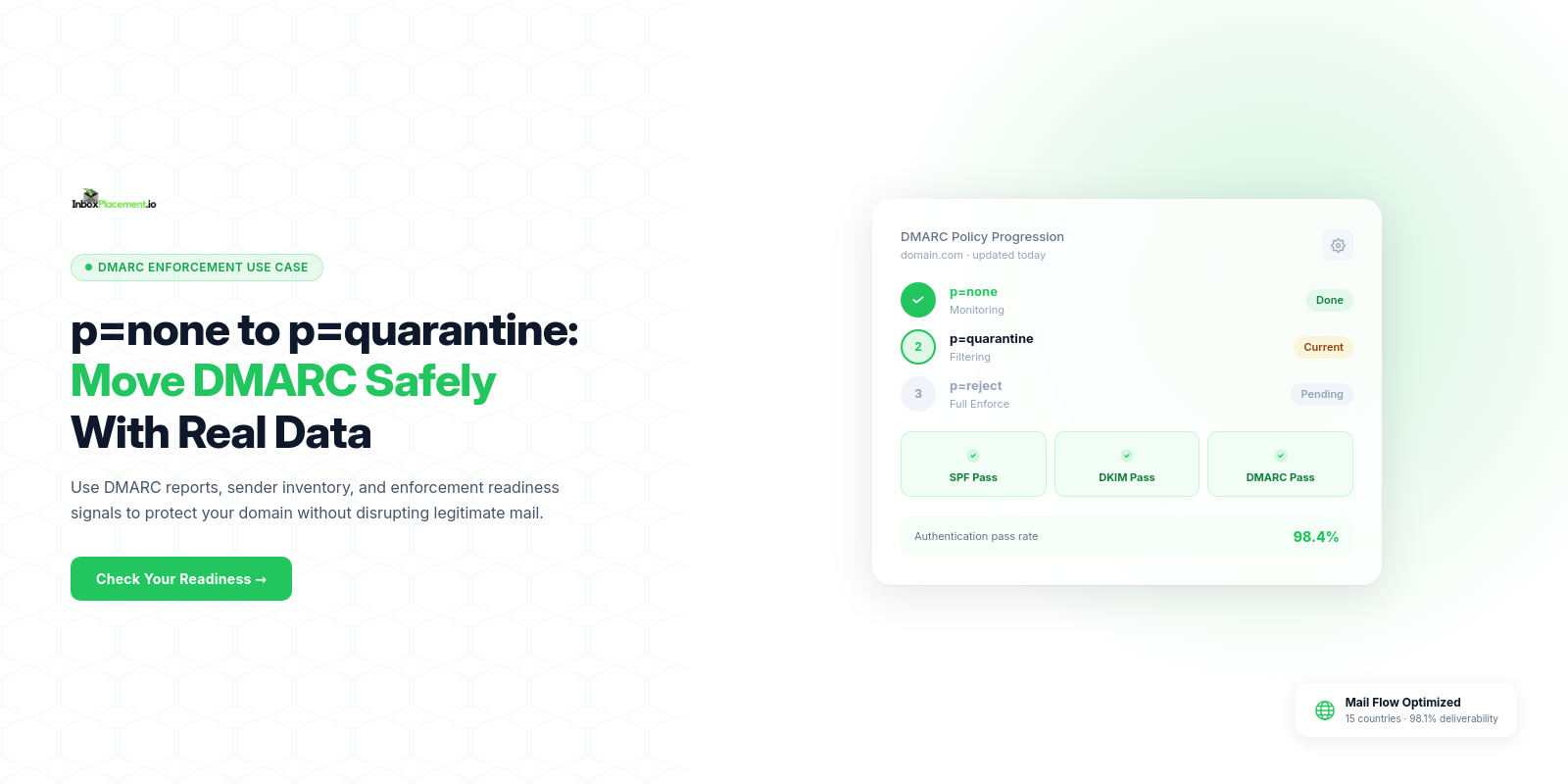
Short answer: move toward p=quarantine only after DMARC reports show that known, legitimate senders are passing with alignment and remaining material failures are understood. Continue monitoring after the change, because new sending tools and DNS changes can create fresh problems.
Publishing a DMARC record with p=none is an important first step, but it does not ask receiving mail systems to quarantine or reject unauthenticated messages. Moving to enforcement can reduce domain impersonation risk, yet doing it before legitimate senders are understood can disrupt business email.
The safe path is evidence-led: monitor, inventory, fix, review, then enforce gradually.
What changes when you move to quarantine?
With a p=none policy, you ask receivers to send reports without requesting enforcement. With p=quarantine, you request suspicious mail that fails DMARC be treated as suspicious, often by placing it in spam or junk. Receiver behavior can vary, so treat this as a policy signal rather than a guarantee of a specific mailbox outcome.
An illustrative record is:
v=DMARC1; p=quarantine; rua=mailto:dmarc-reports@example.com
This example is not a production configuration. Your reporting destination, subdomain policy, alignment settings, and rollout plan should reflect your organization’s mail systems.
Before changing the policy
1. Confirm DMARC reports are arriving and being reviewed
If the reports are not reaching a monitored destination, you are not ready to use them to make enforcement decisions. Make sure the team knows who owns review and how unexpected sources are investigated. DMARC monitoring turns those reports into trends, source inventories, and policy signals.
2. Inventory every valid sender
List employee mail, marketing systems, support tools, invoices, forms, transactional mail, and older platforms. Ask each business owner whether the sender is active and which domain it uses. This is the step most likely to prevent accidental disruption.
3. Verify SPF, DKIM, and DMARC alignment
For each valid sender, check whether SPF or DKIM passes and aligns with the visible From domain. Fix the actual configuration problem rather than weakening the policy to hide it. A DMARC record checker can help validate the published record, but a syntactically valid record does not prove that every sender is aligned.
4. Separate legitimate failures from suspicious activity
Some failures come from a known but incorrectly configured platform. Others may represent a service that was retired, an unknown source, or attempted impersonation. They require different responses.
A staged rollout approach
- Maintain
p=nonewhile the sender inventory and report review are incomplete. - Correct authentication and alignment for active senders.
- Recheck results across a meaningful reporting period for your organization.
- Change to
p=quarantineonly when material legitimate failures are understood. - Continue monitoring after the change; new platforms and DNS changes can introduce new failures.
- Consider
p=rejectonly when evidence supports it and the organization accepts the operational risk.
A practical decision record
Before a policy change, write down the domain, current policy, report-review period, known authorized senders, unresolved failures, change owner, rollback owner, and next review date. This is more useful than a generic timeline because a domain with one sender has different evidence needs from a domain with marketing, support, billing, and custom-product mail.
DMARC monitoring helps maintain that discipline by showing authentication trends, sources, and policy recommendations over time. Review the full DMARC enforcement path before changing a production record.
What enforcement readiness looks like
The decision to move from monitoring to quarantine should be based on your domain’s evidence, not on a calendar deadline. Look for stable authentication and alignment across known senders, an explanation for material failures, and an owner who will continue reviewing reports after the change.
The InboxPlacement.io DMARC monitoring dashboard brings those signals together. In the example below, the dashboard shows 2,104 messages analyzed over the last 30 days, an overall 83% pass rate, and a Ready enforcement status. The individual metrics show where attention is still needed: SPF Authentication is 97%, SPF Alignment is 83%, DKIM Authentication is 98%, DKIM Alignment is 97%, and DMARC Pass is 83%.
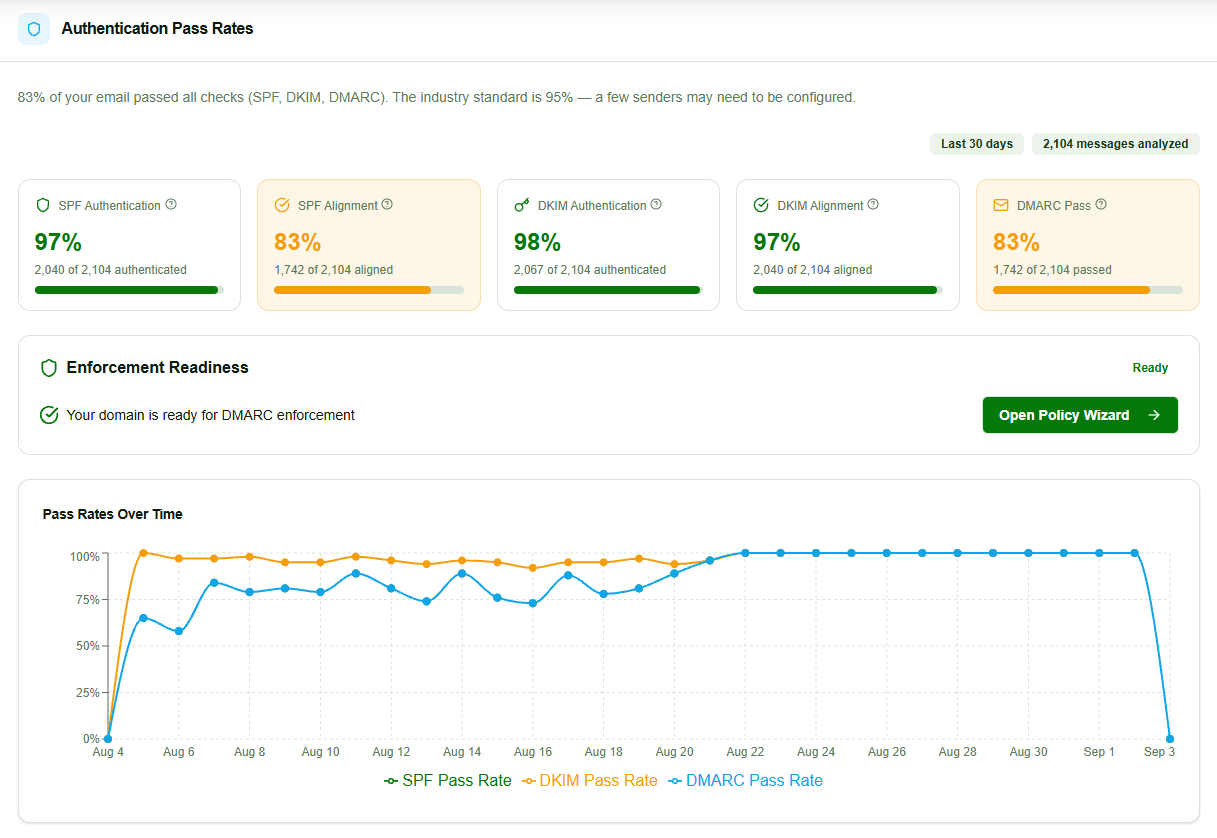
Illustrative InboxPlacement.io monitoring view. The displayed 83% pass rate, 2,104-message sample, and Ready status describe this example dashboard only; they are not a guarantee or a typical result for every domain.
Use a dashboard like this to identify the failing or partially passing signal, trace it to the affected sender, and decide whether the remaining risk is understood before changing the policy. Do not treat a green readiness label as a substitute for reviewing your sender inventory and operational rollback plan.
Common mistakes to avoid
- Adding every observed source to SPF without verifying that it is legitimate.
- Treating a valid SPF result as proof of DMARC alignment.
- Forgetting subdomains, legacy systems, or transactional senders.
- Moving to enforcement because a DNS checker says the record is syntactically valid.
- Making a policy change and then stopping report review.
For SPF-specific configuration issues, use the SPF sender authorization guide alongside your DMARC report review.
What quarantine does—and does not—solve
p=quarantine asks receivers to treat mail that fails DMARC as suspicious. It is a domain-protection policy, not a shortcut for fixing inbox-placement problems caused by weak engagement, poor list quality, or unwanted content. Keep the policy decision and deliverability troubleshooting related but separate: one protects domain identity; the other examines how a particular campaign performs.
If you are preparing for a high-value send, pair the policy review with the email deliverability test before a major campaign. A DMARC policy can protect the identity of your domain, while an inbox placement test helps you understand how the actual campaign performs.
FAQ
How long should a domain stay at p=none?
There is no universal number of days. Stay in monitoring until valid senders are identified, recurring failures are explained, and the organization has a process for new senders.
Will p=quarantine block all spoofing?
It asks receivers to handle messages that fail DMARC as suspicious. Receiver behavior can vary, so continue to monitor rather than treating the policy as a complete security guarantee.
Does DMARC enforcement affect inbox placement?
DMARC is an authentication and domain-protection control. Correctly configured authentication supports trustworthy sending, but inbox placement also depends on content, engagement, reputation, and mailbox-provider evaluation.
Should every domain use the same enforcement policy?
Not automatically. Consider the domain’s purpose, whether it sends legitimate mail, its subdomains, and the quality of the sender inventory and report data. A policy should follow evidence for that domain rather than a blanket rule copied from another organization.
Sources and further reading
Monitor first, enforce from evidence, and keep reviewing reports as your email systems change.