
Email Deliverability · Inbox Placement · Email Testing · Email Authentication · Tool Comparisons
GlockApps Alternative: InboxPlacement.io vs GlockApps
· InboxPlacement.io Team
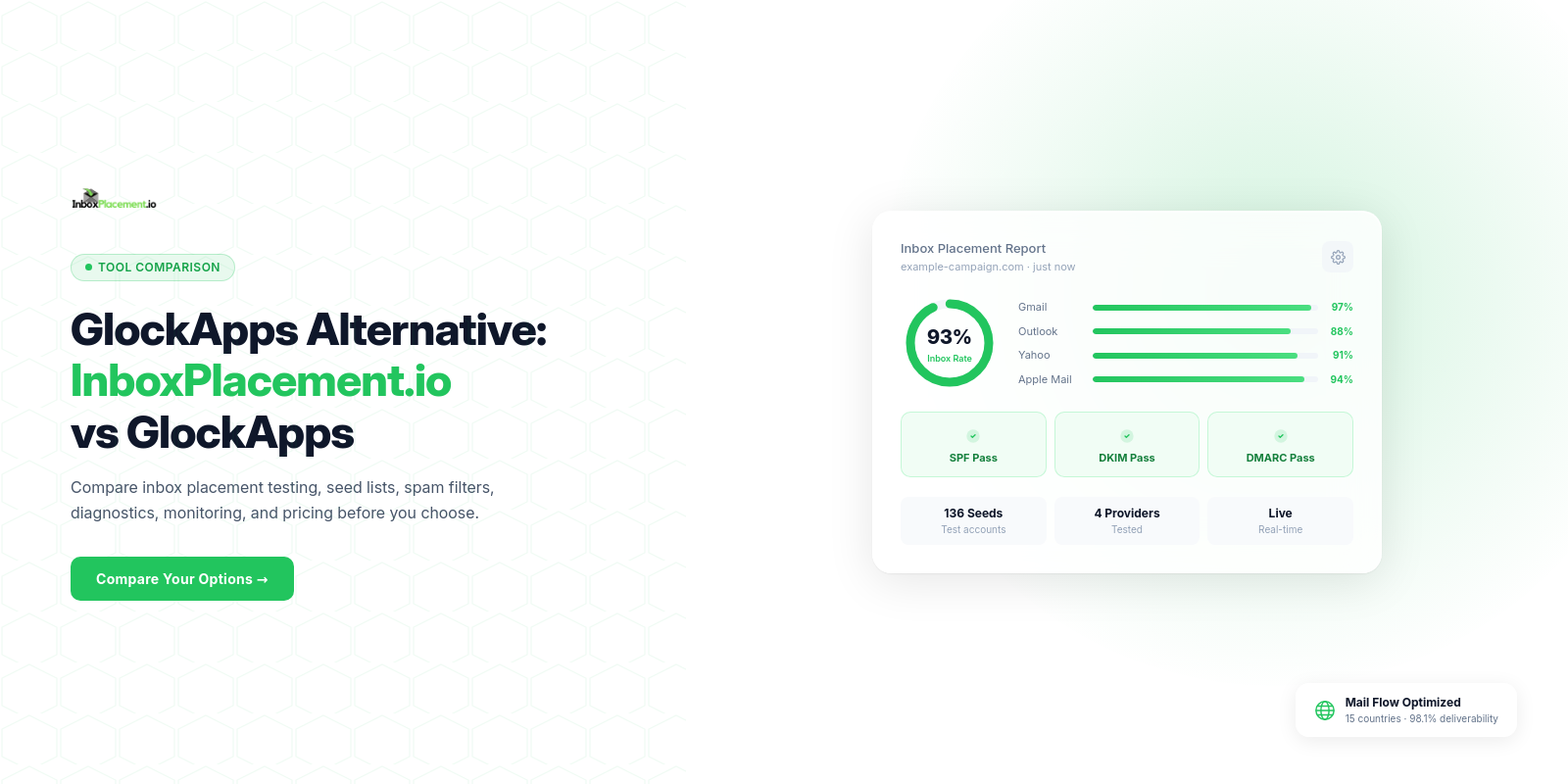
If you are searching for a GlockApps alternative, the better choice depends on how you test email and what you need to do after a message misses the inbox.
GlockApps is a strong fit for agencies, high-volume senders, and deliverability teams that want a mature seed-list workflow, selectable providers and filters, automated tests, and broader monitoring products.
InboxPlacement.io is a strong fit for small and growing teams that want a lower paid entry price, provider-level inbox placement results, and SPF, DKIM, DMARC, SMTP, forensic, and blacklist diagnostics in the same workflow.
Neither tool can guarantee that every future campaign will reach the inbox. Seed-list testing is a controlled measurement. Mailbox providers still make delivery decisions using reputation, engagement, content, list quality, sending behavior, and recipient-specific signals.
Is InboxPlacement.io a Good GlockApps Alternative?
Yes—InboxPlacement.io is a good GlockApps alternative when your priority is affordable inbox placement testing connected to practical troubleshooting. It is especially relevant for small businesses, SaaS teams, marketers, and operators who need to answer two questions in sequence:
- Did the message reach the inbox, spam folder, another provider folder, or nowhere?
- Which authentication, infrastructure, reputation, or content issue should we investigate next?
GlockApps may be the better alternative in the other direction when you need a larger documented test-credit allowance, named spam filters, selectable test settings, recurring automatic tests, IP reputation monitoring, and an agency-oriented operating model.
Choose InboxPlacement.io when you value:
- A lower paid starting point for occasional or moderate testing
- A guided test flow using supplied seed addresses and a unique test token
- Provider-level placement results alongside authentication findings
- One workspace for inbox testing, spam testing, SMTP checks, forensic analysis, and IP blacklist monitoring
- A separate DMARC Monitoring option priced per domain
Choose GlockApps when you value:
- A dedicated Inbox Insight workflow with selectable providers and spam filters
- A publicly documented larger test-credit allowance at paid tiers
- Automatic tests and placement alerts for recurring monitoring
- IP analytics, uptime monitoring, and reputation monitoring in a broader deliverability suite
- A repeatable workflow for agencies and higher-volume sending programs
InboxPlacement.io vs GlockApps at a glance
| Category | InboxPlacement.io | GlockApps |
|---|---|---|
| Core job | Inbox placement, spam testing, authentication, and deliverability diagnostics | Seed-list inbox placement and spam testing with broader monitoring products |
| Placement workflow | Send a message to supplied seed addresses with a unique test token, then review provider and folder results | Create a Spam Test, select filters and providers, send to the test addresses, then review placement |
| Public coverage positioning | 30+ email providers, including Gmail, Outlook, Yahoo, and more | Full test positioning around 115 seed addresses and five named spam filters on public pages |
| Folder visibility | Inbox, spam, and provider-level delivery results; inspect individual seed results | Inbox, spam, and sub-folder placement, including Primary or Promotions where available |
| Spam analysis | Available in the deliverability workflow; confirm plan entitlements for the exact test | SpamAssassin, Barracuda, Microsoft EOP, Proofpoint, and Google filter are named publicly |
| Authentication | SPF, DKIM, DMARC, header, forensic, SMTP, and related diagnostics | Authentication and infrastructure diagnostics within the wider deliverability product experience |
| Monitoring | Real-time IMAP monitoring is advertised; DMARC Monitoring is a separate add-on | Automatic tests, alerts, DMARC Analytics, uptime monitors, and IP Reputation Monitors |
| Public monthly pricing | Starter $9.99; Pro Deliverability $29.99; DMARC Monitoring $19/domain/month | Free $0; Essential $59; Growth $99; Enterprise $129 |
| Best fit | Cost-conscious marketers, small businesses, SaaS teams, and teams that want technical diagnostics beside placement | Agencies, larger senders, and deliverability teams needing high-volume test credits and broad monitoring |
Prices, coverage, and credit rules change. The public pages used for this comparison were checked on August 31, 2026. Confirm the current plan page and checkout before making a purchase.
What an inbox placement testing tool actually measures
An inbox placement test sends a representative email to a controlled group of test mailboxes, commonly called a seed list. The tool checks whether the message arrived, where it landed, and what signals may explain the result.
That is different from a basic spam-score check:
- A spam-score check evaluates message content against filtering rules.
- An inbox placement test measures the observed destination at mailbox providers.
- An authentication diagnostic checks SPF, DKIM, and DMARC configuration or real-message results.
- A reputation monitor tracks a sender IP, domain, or related signal over time.
GlockApps leans toward dedicated seed-list testing, filter coverage, and configurable monitoring. InboxPlacement.io combines inbox placement with technical investigation, which can shorten the path from a poor result to a likely fix.
How InboxPlacement.io works
InboxPlacement.io is built around a guided test loop:
Review the inbox placement testing workflow for an overview of the seed-list process and observed mailbox results.
- Start an inbox placement test.
- Receive the supplied seed addresses and unique test token.
- Include the token in the message and send the campaign email to those addresses.
- Let the platform monitor the test mailboxes.
- Review the score, delivery rate, inbox/spam split, provider results, and diagnostics.
The public site describes real-time IMAP monitoring using actual IMAP connections to real inboxes across providers. Its pricing page advertises testing across 30+ email providers, including Gmail, Outlook, Yahoo, and more.
Depending on the test and plan, the result workflow can include:
- Overall deliverability or inbox placement score
- Inbox, spam, and delivery rates
- Provider and seed-level delivery rows
- Seed addresses used for the test
- A view of the captured email
- PDF export on Pro Deliverability
- SPF, DKIM, and DMARC analysis
- Header-based authentication evidence
- Forensic, SMTP, and infrastructure diagnostics
That context matters when a marketer sees a low inbox rate and needs to investigate whether the cause is authentication, SMTP configuration, a blacklist, message content, or sender reputation.
InboxPlacement.io plans
The public pricing page currently shows:
| Plan | Public price | Publicly highlighted capabilities |
|---|---|---|
| Starter | $9.99/month | 3 inbox placement test credits monthly, basic reporting, email authentication analysis, standard support, spam-test credits, IP blacklist monitoring, and unlimited SMTP and forensic testing |
| Pro Deliverability | $29.99/month | 10 inbox placement credits, 10 spam-test credits, 3 IP blacklist monitoring credits, advanced authentication analysis, PDF reports, priority support, and unlimited SMTP and forensic testing |
| DMARC Monitoring | $19/domain/month | DMARC protection per domain, threat intelligence, policy recommendations, compliance reports, and domain-security analytics |
All plans are described as including instant setup, real-time IMAP monitoring, and deliverability insights. The public page does not display a numeric Starter spam-credit allowance beside the plan, so confirm that detail before checkout.
How GlockApps works
GlockApps calls its core placement product Inbox Insight. Its public Spam Tester page describes a manual flow:
- Create a Spam Test.
- Choose the spam filters and mailbox providers to test.
- Select folder options and add a note if needed.
- Send the message to the provided test addresses.
- Review placement and diagnostic results.
The product pages describe results across the Inbox, Spam folder, and sub-folders. GlockApps also promotes IP analytics that can show sender score, blocklists, Inbox/Tab/Spam placement, rDNS, and HELO details for a primary sending IP.
For recurring monitoring, GlockApps describes automatic tests that send messages to its seed list on a schedule, check placement, and alert users when messages land in spam. That makes it attractive for teams that want an ongoing deliverability watch rather than an occasional pre-send check.
GlockApps filters, credits, and monitoring
GlockApps publicly names five filters:
- SpamAssassin
- Barracuda
- Microsoft Exchange Online Protection (EOP)
- Proofpoint
- Google filter
Its public pricing page currently lists these monthly tiers:
| Plan | Public price | Spam-test credits shown | Other public limits shown |
|---|---|---|---|
| Free | $0/month | 2 | 5 uptime monitors and 1 IP reputation monitor |
| Essential | $59/month | 360 | 15 uptime monitors and 10 IP reputation monitors |
| Growth | $99/month | 1,080 | 25 uptime monitors, 20 IP reputation monitors, and 5 users |
| Enterprise | $129/month | 1,800 | 30 uptime monitors, 25 IP reputation monitors, and 10 users |
GlockApps also advertises annual savings, unlimited DMARC domains, DMARC message allowances, and custom plans. Do not calculate cost per test by dividing these numbers blindly: a GlockApps spam-test credit and an InboxPlacement.io inbox-test credit may represent different events, provider sets, or report scopes.
InboxPlacement.io vs GlockApps: capability comparison
1. Actual inbox placement
Both platforms answer the most important practical question: where did the message land?
GlockApps has a more explicitly documented full-test scale on its public marketing pages, including 115 seed addresses and five named filters. It emphasizes Inbox, Spam, and sub-folder placement.
InboxPlacement.io emphasizes actual IMAP monitoring, a unique test token, provider-level result rows, and a test-to-diagnosis path. Its public pricing page positions the product around 30+ providers.
Advantage: GlockApps for documented breadth and configurable coverage; InboxPlacement.io for a guided workflow that keeps troubleshooting close to the placement result.
2. Seed-list testing
GlockApps offers a classic selectable seed-list workflow. Users choose filters and providers, send the message, and inspect the report. That is useful for agencies that need repeatable configurations across clients and campaigns.
InboxPlacement.io supplies seed addresses and a unique token, then associates received messages with the test. The flow is easier to explain to a small team: start a test, send to the addresses, and wait for provider-level results.
Advantage: GlockApps for selection and high-volume test operations; InboxPlacement.io for guided setup and a lower-friction first test.
3. Spam placement and content diagnostics
GlockApps publicly names five filters and presents spam scoring and content insights as part of Inbox Insight. Filter-by-filter reporting and IP analytics help a specialist investigate whether the issue is content, infrastructure, or reputation.
InboxPlacement.io combines spam testing with domain, SMTP, blacklist, and forensic tools. This is useful when “why did this go to spam?” becomes “is SPF aligned, is DKIM passing, is the sending IP listed, or is SMTP misconfigured?”
Advantage: GlockApps for dedicated named-filter breadth; InboxPlacement.io for connecting spam placement to technical checks in one workflow.
4. SPF, DKIM, DMARC, and authentication
Authentication is not the same as inbox placement. A message can pass SPF and DKIM and still land in spam, while an authentication failure can help explain why a provider distrusts the message.
InboxPlacement.io makes authentication analysis part of its public plan comparison and result workflow. Its diagnostic approach can distinguish a DNS configuration check from authentication evidence observed in real message headers.
GlockApps also promotes authentication, infrastructure, and DMARC-related diagnostics, but those capabilities sit within a broader product family that includes Inbox Insight, DMARC Analytics, uptime monitoring, and IP reputation monitoring. A DMARC report product should not be treated as a replacement for an inbox placement test.
Advantage: InboxPlacement.io for a direct placement-to-authentication investigation; GlockApps for teams that want authentication and DMARC inside a wider monitoring suite.
For background, see SPF Checker: Validate Your Sender Authorization and Fix Common Errors and DMARC Checker: Validate Your Record and Fix Common Errors.
5. Ongoing email deliverability monitoring
GlockApps has the clearer public story for scheduled placement monitoring. It advertises automatic tests and alerts, plus DMARC Analytics, Uptime Monitors, and IP Reputation Monitors.
InboxPlacement.io advertises real-time IMAP monitoring as part of its plans and offers DMARC Monitoring at $19 per domain per month. That fits teams that want inbox testing and domain security without starting with a larger agency-oriented bundle.
Advantage: GlockApps for a multi-module monitoring program; InboxPlacement.io for focused inbox and DMARC monitoring with transparent entry pricing.
6. Reporting and usability
GlockApps is designed for a configurable operator workflow. Selecting filters, providers, folders, and test settings is powerful, but it may be more than a small business needs for a quick campaign check.
InboxPlacement.io is more direct: credits are visible, the test action is prominent, and the user is told how to use the seed addresses and token. The result page brings together score, inbox/spam rates, provider delivery, authentication recommendations, and downloadable reports on Pro.
Advantage: InboxPlacement.io for ease of first use; GlockApps for teams that need a repeatable, highly configurable test operation.
7. Price and value
The most visible paid-entry difference is:
- InboxPlacement.io Starter: $9.99/month
- InboxPlacement.io Pro Deliverability: $29.99/month
- GlockApps Essential: $59/month
That does not mean the lower price automatically offers more value. GlockApps lists substantially more spam-test credits at paid tiers and documents a larger full-test seed list. A high-volume agency may get better operational value from GlockApps despite the higher subscription price.
For a small team running a few campaign checks each month, InboxPlacement.io's lower entry point and bundled diagnostics may be easier to justify. For a team running hundreds of tests, compare how each platform defines and consumes a credit before calculating cost per test.
Advantage: InboxPlacement.io for low-cost entry and bundled diagnostics; GlockApps for high-volume test-credit capacity.
Which tool is better for different teams?
Choose InboxPlacement.io if you are:
- A small business testing occasional campaigns
- A SaaS or product team that wants an email deliverability tool without an agency-sized subscription
- A marketer who wants to understand both placement and authentication
- A team that needs SMTP, forensic, and IP blacklist diagnostics
- Comparing GlockApps alternatives primarily on price and ease of use
- Already managing DMARC and wanting a $19/domain/month monitoring add-on
Choose GlockApps if you are:
- An agency running tests for multiple clients
- A high-volume sender that values a large published test-credit allowance
- A deliverability specialist who wants named spam filters and selectable providers
- Monitoring sender IP reputation, blocklists, and uptime alongside inbox placement
- Looking for automatic scheduled tests and placement alerts
- Building a repeatable operational process around seed-list testing
Consider using both
The tools do not have to be mutually exclusive. A deliverability team might use GlockApps for broad campaign QA and recurring agency tests, then use InboxPlacement.io for lower-cost troubleshooting, authentication analysis, SMTP checks, or DMARC monitoring.
If you compare both, send the same message from the same sending identity as close together as possible:
- Use the same subject line and HTML.
- Keep the same From, Reply-To, and Return-Path behavior.
- Use the same sending IP or provider.
- Test at similar times.
- Define “inbox,” “spam,” “Promotions,” and “not received” consistently.
Do not treat two different seed lists as a laboratory-grade apples-to-apples experiment. Mailbox histories, engagement profiles, filters, and provider mix can produce different outcomes.
How to choose a GlockApps alternative
Before subscribing to an inbox placement testing tool, answer these questions:
- How many tests will we run each month? Occasional checks favor a low entry price. High-volume testing makes credit definitions, automation, and reporting limits more important.
- Do we need provider-level placement or only a spam score? If you need to know whether Gmail, Outlook, Yahoo, or a specific folder received the message, choose an actual placement workflow.
- Do we need authentication diagnostics in the same session? If yes, prioritize SPF, DKIM, DMARC, and header-level diagnostics rather than buying only a content score.
- Do we need scheduled tests and alerts? Agencies and always-on sending programs should compare automation, alert rules, and monitoring limits.
- How many people and domains need access? Confirm team, mailbox, and domain limits for the plan you intend to use.
- What does one credit actually buy? Confirm whether it means one message, one provider set, one complete report, or one scheduled test event.
Frequently Asked Questions
Is InboxPlacement.io a GlockApps alternative?
Yes. InboxPlacement.io is a GlockApps alternative for teams that want inbox placement testing, provider-level results, and technical deliverability diagnostics at a lower public paid entry price. GlockApps may be a better fit for agencies and high-volume teams that prioritize broad seed-list testing, named filters, automation, and monitoring modules.
Which is cheaper, InboxPlacement.io or GlockApps?
InboxPlacement.io currently shows Starter at $9.99/month and Pro Deliverability at $29.99/month. GlockApps currently shows Essential at $59/month, Growth at $99/month, and Enterprise at $129/month, plus a free plan. Prices and limits change, and the platforms do not define credits identically.
Is GlockApps better for seed-list testing?
GlockApps is a strong choice when you need a configurable seed-list workflow with selectable providers and named spam filters. InboxPlacement.io is a strong choice when you prefer a guided token-based workflow and want authentication and infrastructure diagnostics beside the placement result.
Does either tool guarantee inbox placement?
No. Both tools provide controlled measurements. Actual delivery depends on sender reputation, recipient engagement, authentication, content, list quality, sending patterns, mailbox-provider rules, and other signals outside a test platform's control.
What is the difference between spam testing and inbox placement testing?
Spam testing evaluates content and filtering signals. Inbox placement testing sends a real representative message to controlled mailboxes and measures whether it arrives in the inbox, spam folder, another folder, or not at all. A complete email deliverability workflow may use both.
Do I need SPF, DKIM, and DMARC diagnostics with inbox testing?
Usually, yes. Placement results show what happened; SPF, DKIM, and DMARC diagnostics help explain whether authentication or alignment contributed to the result. Authentication passes alone still do not guarantee inbox placement.
How should I compare GlockApps and InboxPlacement.io pricing?
Compare the cost of the workflow you will actually use, not just the monthly sticker price. Confirm how many messages, provider checks, filters, automated tests, users, and reports each credit or plan includes before calculating cost per meaningful test.
The verdict: which GlockApps alternative should you choose?
GlockApps remains a strong choice when inbox placement testing is the center of a larger deliverability operation. Its public materials emphasize a large seed-list test, named spam filters, provider and folder placement, automatic tests, IP analytics, DMARC Analytics, and reputation monitoring. Agencies and high-volume senders should take those strengths seriously.
InboxPlacement.io is a compelling GlockApps alternative for teams that want to start smaller and investigate problems faster. Its lower paid entry price, real-time IMAP monitoring, provider-level results, authentication diagnostics, SMTP and blacklist checks, forensic tools, and DMARC add-on make it a practical all-in-one option for small businesses, SaaS teams, and marketers.
Short recommendation:
- Best for broad, high-volume seed-list operations: GlockApps
- Best for affordable testing plus technical diagnostics: InboxPlacement.io
- Best for agencies: GlockApps
- Best for small businesses and occasional campaign testing: InboxPlacement.io
- Best choice for your team: run the same representative message through both current workflows, compare the reports you actually receive, and calculate the cost per meaningful test.
Ready to connect inbox placement results with technical diagnostics? Check your deliverability workflow at InboxPlacement.io →
Related: Inbox Placement Testing 101: Inbox vs. Spam · Email Deliverability Checker: What Each Test Reveals and What to Fix · Domain Forensic Analysis: What Your Domain Reveals About Email Risk
Sources
InboxPlacement.io
- InboxPlacement.io homepage
- InboxPlacement.io pricing
- InboxPlacement.io FAQ
- Inbox Placement Testing 101