
authentication · spf · dmarc
Return-Path Domain and SPF Alignment Explained
· InboxPlacement.io Team
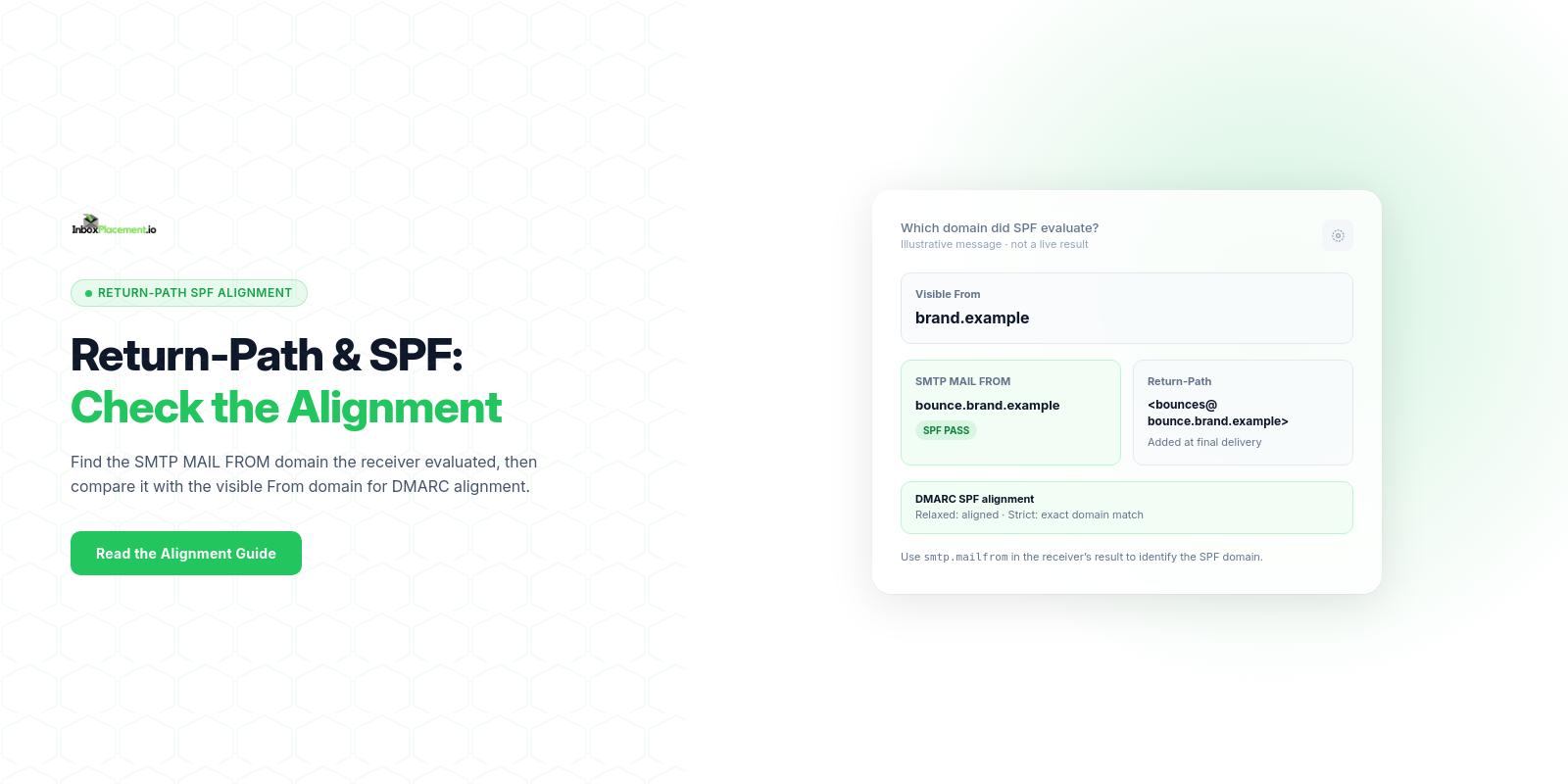
Return-Path and SPF are related, but they are not interchangeable. SPF evaluates an SMTP identity—normally the MAIL FROM reverse-path, and optionally the HELO/EHLO identity. The final delivery server adds a Return-Path header that reflects the message’s reverse-path. When the receiving system records smtp.mailfrom in Authentication-Results, use that value to identify the MAIL FROM domain it evaluated. For DMARC, an SPF pass counts only when that SPF-authenticated domain also aligns with the message’s visible From domain. Authentication results do not prove delivery or inbox placement.
Direct answer: what the signals establish
An spf=pass result means the receiver’s SPF evaluation authorized the connecting client for the identity it checked. It does not by itself mean the SPF domain aligns with the From domain, that DMARC passed, or that the message reached the inbox.
“SPF alignment” usually refers to DMARC comparing an SPF-authenticated domain with the message’s From domain. DMARC can also pass through an aligned DKIM signature, so check the reported SPF, DKIM, and DMARC fields rather than inferring the cause from one result.
The supplied demo screenshot below is a synthetic authentication-failure example; it does not establish a live message’s MAIL FROM or Return-Path identity.
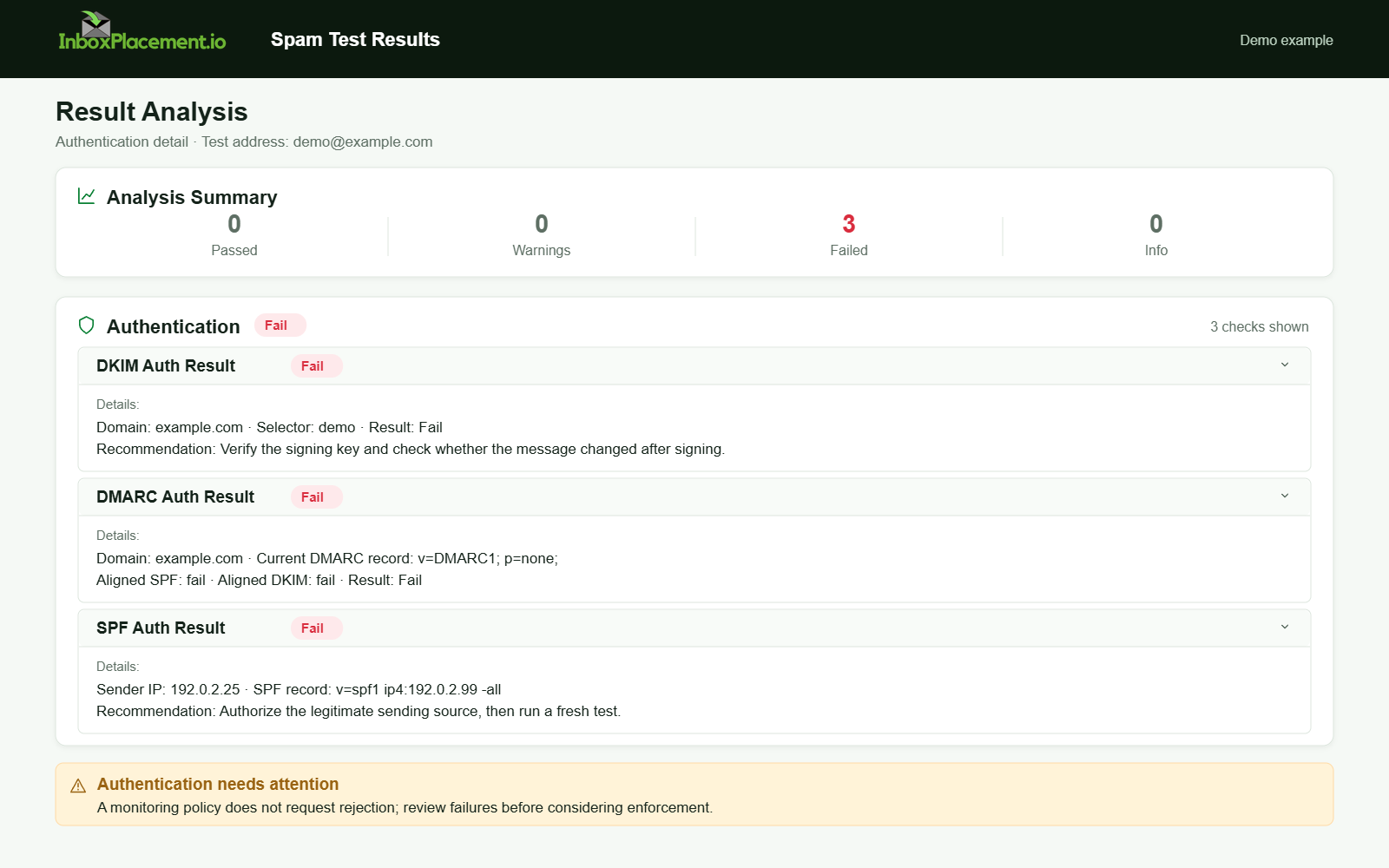
Demo example. Authentication failure diagnosis. Synthetic results for feature explanation; not a live test or customer outcome.
Keep the identities separate
The names can look similar in a mailbox view, but they describe different parts of a message:
MAIL FROM: the SMTP envelope reverse-path. SPF evaluates this identity; for a null reverse-path, RFC 7208 defines the SPFMAIL FROMidentity using theHELOidentity.Return-Path: a header the final delivery system inserts to record the reverse-path. It is useful evidence, but it is not a substitute for the identity reported by the receiver’s authentication result.From: the message-header domain that DMARC protects and compares with authenticated identifiers.HELO/EHLO: the SMTP client’s greeting identity. Receivers may check it separately; DMARC’s SPF-based identifier uses the SPF-validatedMAIL FROMidentity.
For DMARC alignment, relaxed mode compares organizational domains; strict mode requires an exact domain match. A passing SPF result can therefore be aligned or unaligned depending on the domains and the published alignment mode.
Evidence to collect
Before changing a record, save the original message source and identify:
- The receiver’s trusted
Authentication-Resultsentry: notespf,smtp.mailfrom(andsmtp.helowhen relevant),dkim,header.d,dmarc, andheader.from. - The delivered
Return-Pathvalue for comparison. If it differs from the receiver’ssmtp.mailfromresult, do not assume the header alone explains the SPF check. - The
Receivedtrace added by the receiver that performed the check, or its reportedclient-ip. The immediate peer may be a forwarding service rather than the original sender. - The SPF TXT record for the evaluated
MAIL FROMdomain, or theHELOdomain for a null reverse-path. - The visible
Fromdomain, DMARC record and alignment mode, and any DKIM signing domain (d=). - Forwarding or ARC evidence when a message passed through an intermediary. ARC is additional receiver evidence, not a guarantee that a receiver will trust the chain.
Step-by-step interpretation workflow
-
Capture the receiver’s evidence. Preserve the original headers and record
Authentication-Results,Return-Path,From, and the relevantReceivedtrace. Prefer the receiver’ssmtp.mailfromandclient-ipfields over assumptions based on display addresses. -
Identify the SPF domain. Read
smtp.mailfromin the receiver’s result. If the SMTP reverse-path was null, check theHELOidentity used for SPF rather than treating a missing mailbox address as a normalMAIL FROM. -
Check the published policy. Query the SPF TXT record for that evaluated domain and compare its mechanisms with the receiver-reported client IP. Investigate duplicate SPF records, DNS lookup-limit errors, and temporary DNS failures separately.
-
Evaluate alignment separately. Compare the SPF-authenticated
MAIL FROMdomain withheader.fromusing the DMARCaspfmode. Also check whether a passing DKIMd=domain aligns; DMARC may pass by either aligned method. -
Make only an authorized, targeted change. Confirm the sending service and domain owner before adding a sender or changing a record. Do not weaken DMARC policy as a shortcut for an SPF identity or alignment issue.
-
Retest the same path. After an approved DNS change, query the authoritative record again and send a controlled message through the same service. Compare fresh
smtp.mailfrom,spf,header.from,dkim, anddmarcresults. A successful authentication check still does not establish inbox placement.
Interpreting common authentication results
| Receiver result | What it establishes | Next check |
|---|---|---|
spf=pass | The client was authorized for the SPF identity the receiver evaluated. It does not establish DMARC alignment. | Compare smtp.mailfrom with header.from using the domain’s aspf mode. |
spf=fail or spf=softfail | The SPF policy did not authorize the evaluated client, with the result reflecting the policy qualifier. | Confirm the receiver-reported client-ip and smtp.mailfrom; check whether a forwarder was the immediate peer. Do not add an unknown sender. |
spf=permerror | The SPF evaluation encountered a permanent error. Multiple SPF records and exceeding the DNS lookup limit are common causes. | Review the exact evaluated domain and its TXT records before making an owner-approved correction. |
spf=temperror | The SPF evaluation encountered a temporary error, often during DNS lookup. | Check resolver and authoritative DNS availability, then retest; do not treat it as a permanent policy error. |
spf=none | The receiver found no applicable SPF policy for the identity it evaluated. | Confirm the identity first, including whether the message used a null reverse-path and HELO. |
dmarc=pass | At least one authenticated identifier aligned with the visible From domain. | Determine whether SPF, DKIM, or both supplied the aligned pass. |
spf=pass with dmarc=fail | SPF passed, but DMARC did not find an aligned authenticated identifier. | Compare the SPF domain and DKIM d= domain with header.from; check the relevant alignment modes. |
These results describe the receiver’s checks on a particular message. Confirm DNS and header evidence before changing a production policy.
Limitations and conclusions the data cannot support
Authentication-Resultsdescribes a receiver’s authentication checks for one message; it is not a universal statement about delivery or inbox placement.- An SPF pass does not guarantee acceptance, DMARC pass, or inbox placement. Receivers use other authentication, reputation, content, and policy signals too.
- Forwarding changes the connecting peer seen by the next receiver and can cause SPF to fail for otherwise legitimate mail. Inspect the path and DKIM/ARC evidence rather than treating an SPF result alone as proof of spoofing or legitimacy.
- DMARC policy applies to the message’s DMARC evaluation, not to an isolated SPF result. Do not weaken
p=quarantineorp=rejectas a shortcut; any policy change requires owner authorization, a narrow scope, and rollback criteria.
Synthetic header example
The following reserved .example domains show why a passing SPF result does not automatically mean DMARC passes:
From: alerts@brand.example
Return-Path: <bounces@bounce.sender.example>
Authentication-Results: mx.receiver.example;
  spf=pass smtp.mailfrom=bounce.sender.example;
  dkim=pass header.d=sign.sender.example;
  dmarc=fail header.from=brand.example
Here, SPF passes for bounce.sender.example, but that domain does not align with brand.example. The DKIM signature also passes but its d= domain is not aligned with brand.example, so the receiver reports dmarc=fail. The delivered Return-Path reflects the reverse-path; smtp.mailfrom identifies the SPF MAIL FROM domain in the receiver’s result. These are synthetic values, not a live message or test.
Sources
- RFC 7208: Sender Policy Framework — Defines SPF evaluation for the SMTP
MAIL FROMandHELOidentities and records SPF results. - RFC 5321: Simple Mail Transfer Protocol — Describes SMTP reverse-path handling and the
Return-Pathheader added during final delivery. - RFC 9989: Domain-Based Message Authentication, Reporting, and Conformance — Defines the SPF-authenticated identifier used by DMARC and relaxed versus strict identifier alignment.
- Microsoft: Troubleshoot email authentication — Maps common SPF results, including
none,permerror, andtemperror, to diagnostic checks. - Google: Email sender guidelines — Documents current Gmail authentication requirements and the need for identifier alignment on direct mail.
FAQ
Does the Return-Path header prove which SPF identity was checked?
Not by itself. The receiving system adds Return-Path at final delivery. Use the receiver’s smtp.mailfrom or, for a null reverse-path, its recorded HELO identity to identify the SPF evaluation.
Can SPF pass while DMARC fails?
Yes. The SPF-authenticated domain may not align with the message’s From domain, and there may be no aligned passing DKIM signature. Check both identities and their alignment modes before changing DNS or DMARC policy.
Does SPF pass mean the message reached the inbox?
No. It reports an authentication result for one receiver and message. Delivery and inbox placement are separate outcomes that require their own evidence.